Best Shopify AI Chatbot Features to Look for in 2026
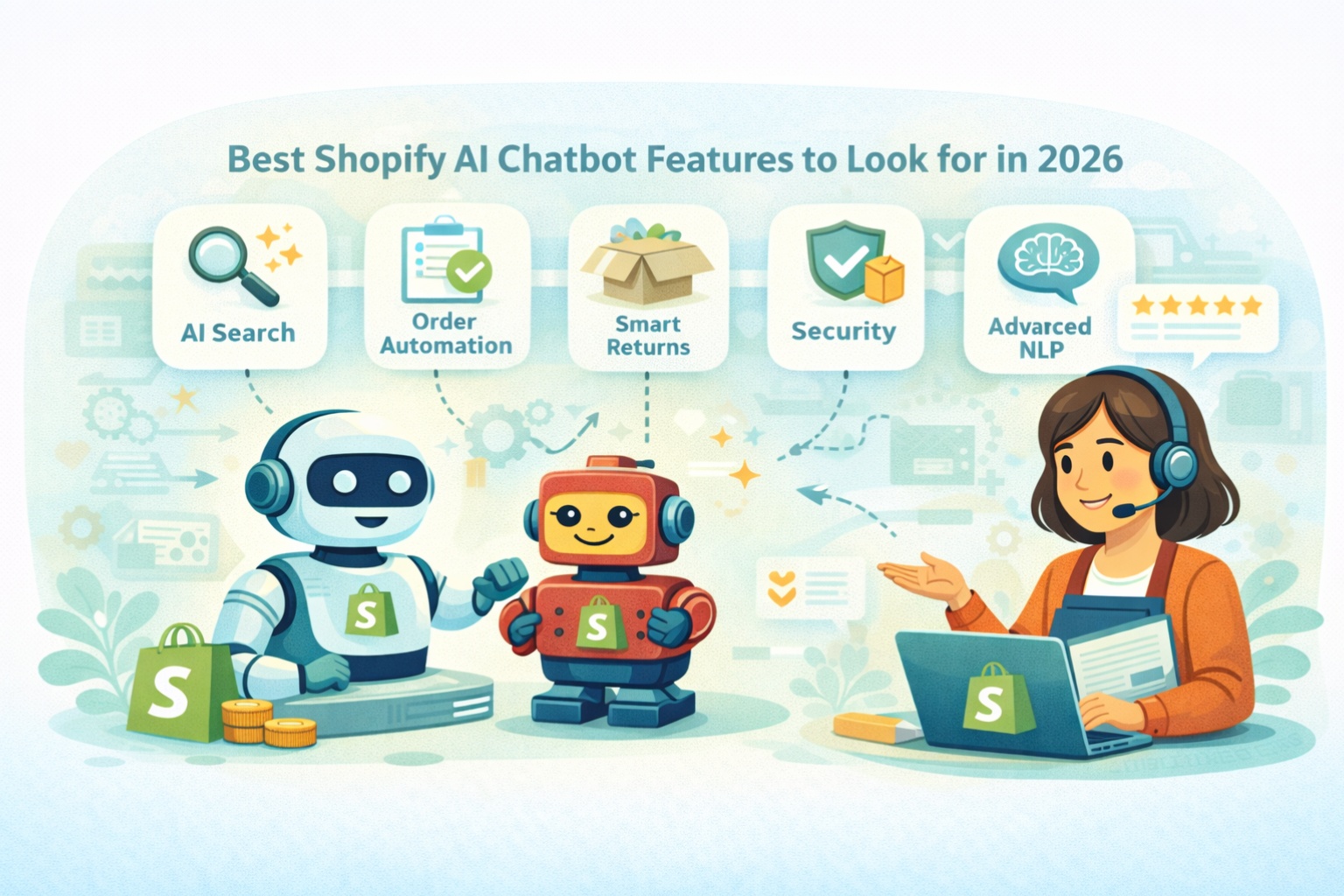
The AI chatbot market has changed more in the past two years than it did in the previous decade. What used to be a glorified FAQ menu with canned responses has become a genuine sales and support engine capable of understanding context, pulling live store data, generating personalized recommendations, and completing transactions without human involvement.
For Shopify store owners evaluating chatbot tools in 2026, the challenge is no longer whether to use one. The question is which features actually matter and which are marketing noise. There are dozens of tools competing for your subscription, each claiming to be the most intelligent, the most integrated, and the easiest to set up. Some of those claims are true. Many are not.
This guide is written for Shopify store owners who want a clear, honest breakdown of the chatbot features that deliver real results in 2026. Not a list of every feature every tool offers, but a focused look at what separates a chatbot that increases revenue and reduces support costs from one that frustrates customers and wastes your money.
Every feature covered in this article is evaluated through one lens: does it make your store more money, save your team time, or improve the experience for your customers? If a feature does not clear at least one of those bars, it does not belong in this guide.
Why Shopify Chatbot Requirements Have Changed Heading into 2026
To understand what features matter now, it helps to understand what changed and why the bar moved.
Three years ago, a Shopify chatbot was considered effective if it could answer basic questions about shipping times, return policies, and order status without a human agent. The automation was mostly rule-based: if a customer typed a certain keyword, the bot returned a preset answer. That was genuinely useful because it saved agent time on repetitive questions.
By 2025, large language models became embedded in most commercial chatbot platforms. This shifted customer expectations significantly. Shoppers who had used ChatGPT, Google Gemini, and similar tools in their personal lives started expecting the same fluency and contextual understanding from brand chatbots. A bot that replied with "I did not understand your question. Please choose from the following options:" felt broken by comparison.
At the same time, Shopify's own data showed that ecommerce competition intensified sharply. Conversion rates became harder to improve through traditional means like ad spend and SEO alone. The brands gaining ground were the ones creating better on-site experiences, and conversational AI became a measurable lever for that.
In 2026, the features that mattered in 2022 are now baseline expectations. The features that differentiate a good Shopify chatbot today are more sophisticated: agentic action-taking, multimodal inputs, cross-channel memory, revenue attribution, and predictive engagement. This guide walks through all of them.
Feature 1: Deep Native Shopify Integration
Every other feature on this list depends on this one working properly. A chatbot that is not deeply integrated with your Shopify store is a chatbot that cannot do its job.
Deep native Shopify integration means the chatbot has real-time, bidirectional access to your store data. Not a synced copy of your product catalog that updates every few hours. Not a limited read-only connection that can retrieve order numbers but cannot take action. Real, live access to the data and systems that power your store.
In 2026, what deep integration looks like in practice:
-
The chatbot can retrieve any order's current status, including carrier-level tracking data, in the same conversation where the customer asks about it.
-
It can check inventory in real time and tell a customer whether a specific variant (size, color, configuration) is in stock.
-
It can apply discount codes, start a return, update a shipping address, cancel an order within the allowed window, and process an exchange without routing the customer to a separate page or agent.
-
It can read and write to customer profiles, using order history, support history, loyalty tier, and current session behavior to give contextually relevant responses.
Tools that offer this level of integration in 2026 include Gorgias, Tidio with its Shopify sync enabled, and purpose-built tools like Yuma AI and Richpanel. The key question to ask any vendor is whether the integration is native (built specifically for Shopify) or generic (built via a third-party connector like Zapier). Native integrations are faster, more reliable, and far less likely to break after a Shopify update.
According to a 2024 Shopify Partners survey, stores using chatbots with native Shopify integration resolved customer inquiries 61% faster than those using tools connected through third-party APIs. That speed difference directly affects customer satisfaction and conversion.
Feature 2: Generative AI with Brand Voice Control
Rule-based chatbots are effectively obsolete for customer-facing interactions in 2026. The standard is now generative AI, meaning the chatbot constructs its responses rather than selecting from a library of pre-written answers.
Generative AI matters for two reasons. First, it handles the enormous variety of ways customers phrase the same question. A rule-based bot might recognize "what is your return policy" but fail on "can I send this back if it doesn't fit?" or "I need to return something I bought three weeks ago, is that still possible?" A generative model understands all three as the same request.
Second, generative AI produces responses that feel like natural conversation rather than canned scripts. Customers who feel they are talking to something intelligent are more patient, more likely to complete a purchase, and less likely to rate the support experience negatively.
But raw generative capability is not enough. The critical feature here is brand voice control: the ability to configure the chatbot's tone, personality, and communication style to match your brand.
-
A luxury fashion brand should have a chatbot that speaks with precision and warmth.
-
A streetwear brand for teenagers should have a chatbot that is casual, direct, and occasionally funny.
-
A B2B Shopify store selling industrial supplies needs a chatbot that is professional, technical, and efficient.
In 2026, the best chatbot platforms allow you to provide brand guidelines, sample conversations, tone of voice documentation, and approved vocabulary that the AI uses to stay on-brand. Some platforms allow you to upload your existing help content and customer conversations as training material so the AI learns your brand's specific communication style.
What to look for when evaluating this feature: ask the vendor for a live demo with your actual products and real customer questions from your support inbox. A chatbot that sounds right for your brand in a generic demo but sounds robotic or off-brand with your specific content is not the right tool for you.
Feature 3: Proactive Engagement and Behavioral Triggers
Most shoppers who visit your Shopify store and leave without buying will never come back. The average ecommerce visitor requires multiple touchpoints before converting, and for many categories, the first visit is a research session rather than a buying session.
Proactive engagement is the feature that changes this dynamic. Instead of waiting for a customer to click the chat bubble, the chatbot initiates a conversation based on what the customer is doing on your site.
Behavioral triggers are the mechanism. These are conditions you define that cause the chatbot to send a message proactively. Common and effective triggers include:
-
A visitor spends more than 60 seconds on a product page without adding to cart. The chatbot opens with "Do you have questions about this product? I can help with sizing, materials, or delivery times."
-
A visitor adds items to their cart and then stops interacting for 90 seconds. The chatbot asks if they are ready to check out and can apply a discount.
-
A returning customer arrives on the site. The chatbot greets them by name and references their last purchase.
-
A visitor is on the checkout page and appears to be hesitating. The chatbot offers reassurance about the return policy, delivery guarantee, or payment security.
-
A visitor is browsing a product that is low in stock. The chatbot proactively alerts them that only a few units remain in their size.
Research from Drift and Intercom consistently shows that proactively triggered chat messages have significantly higher engagement rates than passive chat widgets. In 2024 data published by Re:amaze, proactively triggered conversations converted to purchases at 3 to 4 times the rate of reactive chat sessions.
When evaluating this feature, look for flexibility in trigger conditions (time on page, scroll depth, exit intent, cart value, device type, traffic source), the ability to suppress triggers for returning customers who have already interacted with the bot, and A/B testing capability so you can optimize message timing and copy.
Feature 4: Omnichannel Inbox and Conversation Management
Your customers do not stay in one channel. They might discover your product on Instagram, visit your website and start a chat, abandon their cart and receive an SMS, and then reply to that SMS with a follow-up question. If each of those interactions lives in a separate system, you get a fragmented picture of each customer and they get a fragmented experience.
An omnichannel inbox brings all customer conversations into one unified view: website chat, email, SMS, WhatsApp, Instagram DMs, Facebook Messenger, and any other channel your customers use to reach you.
In 2026, this is not just about agent convenience. It is about conversation continuity. The AI chatbot should have access to the full history of a customer's interactions across every channel so it can pick up where the last conversation left off, regardless of which channel the current conversation is happening in.
A customer who messaged your Instagram DM two days ago asking about a product and now has a question in your website chat should not have to re-explain their situation. The chatbot should recognize them, reference the prior conversation, and continue seamlessly.
The platforms that do omnichannel conversation management well for Shopify stores in 2026 include Gorgias, which supports 15 plus channels in a single inbox, Re:amaze, which has strong mobile inbox management, and Freshdesk, which is popular for stores with larger support teams.
When evaluating omnichannel features, ask specifically about conversation threading (do messages from the same customer across different channels get linked?), response time tracking across channels, and SLA management for each channel type.
Feature 5: AI-Powered Product Recommendation Engine
Product recommendations are one of the highest-ROI features in ecommerce. McKinsey data from 2023 showed that 35% of Amazon's revenue is generated by its recommendation engine.
An AI chatbot with a built-in product recommendation engine does something a static "you might also like" widget cannot: it asks questions, understands context, and recommends based on what the customer actually tells it about their needs.
The difference between passive recommendations (a widget showing related products based on browsing history) and conversational recommendations (a chatbot asking questions and recommending based on answers) is significant. Passive recommendations have an average click-through rate of 3% to 5%. Conversational recommendations, according to data from Tidio and Octane AI, achieve click-through rates of 15% to 30% because the product surfaced is actually relevant to what the customer said they need.
In 2026, this feature should include:
-
A quiz or question flow that gathers customer intent before making recommendations.
-
Real-time inventory awareness so the chatbot never recommends a product that is out of stock in the required variant.
-
Upsell and cross-sell awareness so the chatbot can suggest complementary products when a customer is moving toward checkout.
-
Personalized recommendation history so a returning customer sees recommendations based on past purchases, not just the current session.
-
The ability to connect recommendation logic to your existing merchandising rules (promoting high-margin products, surfacing new arrivals for repeat customers).
Brands using conversational product finders powered by AI report average order value increases of 15% to 25% compared to shoppers who did not engage with the recommendation flow, according to data published by Octane AI in their 2024 merchant benchmark report.
Feature 6: Order Management and Self-Service Actions
Answering questions about orders is valuable. Taking action on orders is transformative.
The most time-consuming customer service tasks in ecommerce are not answering questions. They are processing returns, updating addresses, resending order confirmations, applying discounts, cancelling orders, and initiating exchanges. Each of these tasks requires an agent to open Shopify's admin, navigate to the relevant order, and take manual action. For high-volume stores, this consumes enormous amounts of agent time.
A Shopify AI chatbot with self-service order management capability can handle all of these tasks automatically, within the chat conversation, without agent involvement. In 2026, the specific self-service actions that the best chatbots can handle include:
-
Return initiation: The chatbot confirms eligibility, generates a prepaid return label, and logs the return in Shopify and the connected returns platform.
-
Address updates: If the order has not yet shipped, the chatbot verifies the customer's identity, confirms the new address, and updates it in the system.
-
Order cancellation: If the order is within the cancellation window, the chatbot processes the cancellation and triggers any associated refund.
-
Exchange processing: The chatbot checks inventory for the requested alternative, reserves it, triggers the return of the original item, and places the exchange order.
-
Discount application: If a customer asks for a discount code or if applying one would prevent a return or cancellation, the chatbot can apply an approved discount automatically.
-
Duplicate order detection: The chatbot can identify when a customer has placed a duplicate order and offer to cancel one.
According to Gorgias's 2024 ecommerce benchmark report, stores using self-service automation for order management reduced ticket volume by 30% to 40%, with the majority of that reduction coming from return, cancellation, and address update requests.
Feature 7: Intelligent Escalation and Human Handoff
A chatbot that handles everything poorly is worse than one that handles most things well and escalates the rest effectively. Intelligent escalation is the feature that separates chatbots that damage customer relationships from those that protect them.
In 2026, the escalation features that matter are:
-
Sentiment detection: The chatbot monitors the emotional tone of the conversation in real time. When a customer's language indicates frustration or distress, the system flags the conversation for priority human review.
-
Confidence scoring: The AI internally evaluates how confident it is in its response. When confidence falls below a defined threshold, the system escalates rather than sending a low-quality automated response.
-
High-value customer detection: Customers with VIP tags, high lifetime value, or loyalty status get prioritized routing to senior agents or dedicated account managers.
-
Seamless context transfer: When escalation happens, the human agent receives the complete conversation history, the customer's Shopify profile data, and an AI-generated summary of the issue and what the chatbot already attempted.
-
Time-based escalation rules: Outside business hours, the chatbot handles a wider scope autonomously. During hours, certain conversation types escalate immediately.
Research from Zendesk found that 72% of customers expect the agent they are transferred to to already know their contact history and issue. Chatbots that pass this context automatically dramatically improve the post-escalation experience.
Feature 8: Multilingual Support
If your Shopify store ships internationally or serves customers in more than one language, multilingual chatbot support is not optional. It is a requirement.
The straightforward version of this feature is language detection: the chatbot detects the language the customer is writing in and responds in the same language. In 2026, this baseline is achievable with most platforms because it relies on underlying language models that support dozens of languages natively.
The more important version is quality consistency across languages. A chatbot that handles English inquiries fluently but struggles with French, German, Spanish, or Japanese is giving your international customers a worse experience than your domestic ones.
When evaluating multilingual support, test the chatbot in your most important non-English languages with real customer questions. Do not rely on vendor claims. Ask for case studies from merchants serving those markets. Check whether the chatbot's product recommendation and order management features work in all supported languages, not just the FAQ answering capability.
According to a 2024 CSA Research study, 76% of online shoppers prefer to buy products with information in their native language, and 40% will not buy from websites only available in other languages. For Shopify stores with international ambitions, multilingual capability directly affects revenue.
Feature 9: Cart Abandonment Recovery via Chat
Cart abandonment is ecommerce's most persistent revenue leak. The Baymard Institute's aggregate data across 49 studies puts the average cart abandonment rate at 70.19%. For every 10 customers who add something to their cart, 7 leave without buying.
Cart abandonment recovery via chat is a distinct and more effective feature than standard abandoned cart emails because it uses conversational channels (SMS, WhatsApp, chat) that have dramatically higher open and response rates than email.
In 2026, the best Shopify AI chatbots handle cart recovery with a level of intelligence that goes beyond a generic reminder. The key capability advances are:
-
Personalized abandonment messaging: The recovery message references the specific items in the cart by name, includes an image where possible, and addresses the customer by name.
-
Reason identification: Some chatbots can ask customers why they abandoned and respond with a tailored offer. If the reason is shipping cost, the bot offers free shipping. If it is price, it applies a limited-time discount.
-
Multi-touch sequences: A well-designed sequence (first message at 30 minutes, second at 24 hours with a small incentive, third at 72 hours as a final prompt) recovers significantly more carts than a single message.
-
Cross-channel recovery: If the customer does not respond to an SMS, the next touch might be a WhatsApp message. The chatbot manages sequencing across channels based on where the customer has opted in.
Klaviyo's 2024 benchmark data showed that abandoned cart SMS flows generated 33 times more revenue per recipient message compared to standard promotional SMS campaigns. The combination of high intent and personal relevance makes abandoned cart recovery one of the highest ROI applications of Shopify chatbot technology.
Feature 10: Analytics, Revenue Attribution, and Reporting
You cannot improve what you cannot measure. Every Shopify AI chatbot should provide clear, actionable data on what it is doing, how well it is doing it, and what it is contributing to your business.
In 2026, the analytics features that matter for Shopify store owners are:
-
Revenue attribution per conversation: The ability to see, for each completed chat conversation, whether the customer made a purchase, what they purchased, and the revenue value of that purchase.
-
Containment rate: The percentage of conversations fully resolved by the AI without human escalation. Most well-implemented Shopify chatbots in 2026 achieve containment rates of 55% to 75% for tier 1 inquiries.
-
Topic distribution: A breakdown of what customers are asking about most frequently. This data tells you which product pages need better information and which policies generate the most confusion.
-
Response quality monitoring: The ability to review AI responses that received low satisfaction ratings, triggered escalations, or prompted follow-up questions.
-
A/B testing results: Clear data on which message variants, triggers, or flows performed better and by how much.
Gorgias's revenue statistics dashboard is frequently cited as a best-in-class example of revenue attribution in customer service. It shows exactly which support tickets, automated flows, and chat conversations generated purchases. For Shopify stores, this level of visibility makes the argument for chatbot investment much easier to make.
Feature 11: Post-Purchase Engagement and Retention Flows
Acquiring a customer is the expensive part. Keeping them is where the profit lives. Post-purchase engagement is one of the most underused capabilities in Shopify AI chatbots, and it is one of the highest leverage opportunities in 2026.
In 2026, the specific post-purchase flows that drive measurable results include:
-
Delivery confirmation and check-in: A message sent after confirmed delivery that acknowledges the package has arrived and asks if everything looks good. This catches issues before the customer leaves a negative review.
-
Review solicitation: A message sent 7 to 10 days after delivery asking for a review with a direct link. Customers prompted by a friendly conversational message are significantly more likely to leave reviews than those who receive a generic email.
-
Replenishment reminders: For consumable products, a message sent when the product is expected to run out based on purchase date and typical usage cycle.
-
Cross-sell recommendations: Based on what the customer purchased, the chatbot surfaces complementary products at the right time.
-
Loyalty enrollment: New customers who have not yet joined a loyalty program receive an invitation after their first purchase, when satisfaction is at its peak.
-
Win-back campaigns: Customers who have not purchased in 60, 90, or 120 days receive a re-engagement message with a personalized incentive based on their purchase history.
Research from Bain and Company found that increasing customer retention rates by 5% increases profits by 25% to 95%. Post-purchase chatbot flows are among the most direct tools for improving retention because they create consistent touchpoints that reinforce the relationship between customer and brand.
Feature 12: AI Training from Your Own Content
A chatbot is only as good as the knowledge it draws on. In 2026, the best Shopify AI chatbots can be trained on your specific content: your product catalog, your FAQ pages, your help center articles, your return policy, your sizing guides, and your historical customer conversations.
This training process, often called retrieval-augmented generation (RAG) in technical documentation, allows the chatbot to answer questions about your specific products and policies accurately, without hallucinating information it does not have.
The practical importance of this feature is significant. A generic AI model knows how ecommerce works in general. It does not know that your store's return window is 45 days instead of the standard 30, that your size small runs large, that your products are made in Portugal, or that you offer a lifetime warranty on your hardware products. Without training on your content, the chatbot will either give generic answers or make up specific details that are wrong.
In 2026, the training features that distinguish better platforms include:
-
Automatic sync with your Shopify product catalog, so product information in the chatbot stays current when you update titles, descriptions, variants, or pricing.
-
Help center integration so the chatbot can draw on your existing documentation without requiring you to rebuild it in a new format.
-
Conversation learning where the chatbot can be updated based on how human agents responded to questions the bot failed to handle well.
-
Confidence-based knowledge gap reporting, where the platform identifies questions the bot is frequently uncertain about so you know exactly where to add content.
Feature 13: GDPR, CCPA, and Data Privacy Compliance
This is not a glamorous feature, but it is a non-negotiable one. Any chatbot handling customer conversations collects personal data: names, email addresses, order details, payment references, shipping addresses, and in some cases sensitive details shared voluntarily in conversation.
In 2026, data privacy regulations have expanded and tightened. GDPR in Europe, CCPA in California, PIPEDA in Canada, and similar laws in Australia, Brazil, India, and the UK all impose requirements on how customer data is collected, stored, processed, and deleted.
The compliance features to look for in a Shopify AI chatbot include:
-
Data residency options: Where is conversation data stored? For European customers, GDPR requires that personal data be stored within the EU or in countries with adequate protection.
-
Consent management: The chatbot should display appropriate consent notices when collecting personal data. For SMS and WhatsApp, explicit opt-in consent must be recorded.
-
Data deletion: The ability to delete a specific customer's conversation history upon request, in compliance with right-to-erasure requirements under GDPR.
-
Encryption: Conversation data should be encrypted in transit and at rest using current encryption standards.
-
Third-party audits: Reputable platforms in 2026 publish SOC 2 Type II compliance reports and GDPR data processing agreements.
Do not rely on vendor claims on their website for compliance verification. Ask for their Data Processing Agreement (DPA) before signing any contract. Review it with a legal professional if your business operates in multiple jurisdictions.
Feature 14: Mobile-First Design and Performance
More than 70% of Shopify traffic comes from mobile devices, according to Shopify's own platform data. A chatbot that performs well on desktop but poorly on mobile is failing the majority of your customers before the conversation even begins.
Mobile-first design in 2026 means more than the chat widget being responsive. It means the entire conversational experience is optimized for a small touchscreen with intermittent connectivity. Specific mobile performance factors to evaluate:
-
Load time: The chat widget should not add meaningful load time to your store pages. A widget that delays page rendering affects your Core Web Vitals scores.
-
Touch target sizing: Buttons, quick reply options, and menu items must be large enough to tap accurately on a phone screen.
-
Keyboard behavior: When a mobile user opens the chat and the keyboard appears, the interface should scroll appropriately so the input field and recent messages remain visible.
-
Image handling: Product images sent by the chatbot should be compressed and optimized for mobile data connections.
-
Offline and low-connectivity handling: A mobile customer on a slow connection should see a meaningful experience, not a blank widget or a frozen loading state.
Test any chatbot you are evaluating on at least three different mobile devices before making a purchasing decision. Many chatbot demos are conducted on desktop in controlled conditions. Real customer experiences happen on phones, in varied conditions, with varying connection quality.
Feature 15: Integration with Your Broader Tech Stack
A Shopify AI chatbot does not operate in isolation. It needs to share data with the other tools your store relies on: your email marketing platform, your SMS tool, your loyalty program, your reviews platform, your returns management system, your ERP, and your analytics dashboards.
In 2026, the depth of these integrations is a meaningful differentiator. A chatbot that connects to your Klaviyo account can enroll customers in email flows based on what they said in a chat conversation. A chatbot that connects to your Yotpo or Okendo reviews platform can send review requests at the optimal moment based on chat feedback.
When evaluating tech stack integrations, ask for a specific list of native integrations (built and maintained by the chatbot vendor) versus connector-based integrations (routed through Zapier, Make, or similar middleware). Native integrations are more reliable, typically faster, and better supported.
The integrations that matter most for most Shopify stores in 2026 are Klaviyo or your primary email/SMS platform, your reviews platform, your returns management system, your loyalty program, your analytics platform (Google Analytics 4, Triple Whale, or Northbeam), and your ERP or inventory management system if applicable.
Feature 16: Human Agent Workspace and Collaboration Tools
Even the most capable AI chatbot will have conversations that need a human. How well the platform supports those human agents is a feature worth evaluating carefully, especially if you have a team.
In 2026, the human agent workspace features that matter in a Shopify chatbot platform include:
-
Unified customer context panel: When an agent picks up a conversation, they should see the customer's Shopify data in the same window as the chat, without switching tabs.
-
AI-assisted responses: The AI should suggest responses to human agents based on conversation context, customer account data, and your knowledge base. Agents can accept, edit, or override.
-
Internal notes and tagging: Agents should be able to leave notes visible to teammates but not customers. Tagging by conversation type enables better reporting.
-
SLA monitoring: For stores with response time commitments, the workspace should show which conversations are approaching or breaching SLA thresholds.
-
Collision detection: Two agents should not be able to reply to the same conversation simultaneously without knowing the other is doing so.
-
Workload management: Supervisors should be able to see agent workloads in real time, reassign conversations, and monitor queue depth across channels.
How to Evaluate and Choose the Right Chatbot for Your Shopify Store
Features matter, but the right chatbot is the one that matches your specific situation. Here is a practical evaluation framework for 2026:
Start with your support data. Look at your last 90 days of customer support contacts. What are the top 10 questions or requests? Which are repetitive and predictable (high automation potential)? Which require judgment or emotion (lower automation potential)?
Calculate your current support cost. Know what you are spending per month on customer support, including staff time, platform costs, and opportunity cost. Any chatbot investment should be evaluated against this baseline.
Check the integration list carefully. Make a list of every tool your store currently uses that the chatbot would need to connect with. Confirm, specifically, that each integration is native and current.
Read the pricing structure thoroughly. Model your expected usage volume under the pricing structure and compare total cost of ownership over 12 months, not just the listed monthly price.
The Features That Are Overhyped in 2026
Not every feature a chatbot vendor leads with is worth paying for. Here are the capabilities that get more marketing attention than they deserve.
Voice commerce. Voice-based shopping via smart speakers has not grown as predicted. Most chatbot platforms now offer a voice feature, but the real-world usage rates for Shopify stores remain low. It is not a priority feature for most merchants.
Augmented reality product visualization in chat. Impressive in demos, rarely used in practice. The friction of enabling AR in a chat conversation is high enough that most customers abandon the flow before seeing it.
Social media monitoring and automated response to public comments. Automated responses to public Instagram or Facebook comments carry reputational risk. A bot that misreads a sarcastic comment or responds inappropriately in a public forum creates a very public problem.
AI that learns from every conversation without human review. Unsupervised learning from customer conversations sounds powerful but in practice creates risk. Without human review of what the AI is learning, the model can gradually drift toward incorrect or off-brand responses. Supervised improvement with human sign-off is safer and more reliable.
How goodChatBot can help
goodChatBot can help by giving Shopify stores a chatbot that is built around ecommerce needs instead of generic website use cases. It can be configured using your product catalog, FAQs, policies, and support workflows so the chatbot can answer real customer questions more accurately.
This makes it easier to support important use cases like product discovery, order related questions, shipping queries, returns, and other common support requests. Instead of giving vague or generic answers, the chatbot can be aligned with your actual store data and customer journey.
goodChatBot can also help reduce support load while improving the shopping experience. Customers get faster answers, your team spends less time on repetitive questions, and the chatbot can be improved over time based on real conversations and store specific needs. That makes it a more practical long term solution for Shopify stores looking for useful AI features in 2026.
Conclusion
The best Shopify AI chatbot in 2026 is not the one with the most features. It is the one that does the right things well: connects deeply to your store data, understands your customers' questions, takes action on their behalf, reaches out at the right moment, and passes the conversation to a human when it should.
The 16 features covered in this guide are not equally important for every store. Your priority should be determined by your specific situation: your support volume, your customer base, the channels they use, and the problems costing you the most revenue or time right now.
Start with the foundation (deep Shopify integration, generative AI with brand voice control, and reliable escalation) and build from there. Add proactive triggers when you have enough traffic to justify them. Add omnichannel management when your volume across channels becomes unmanageable. Add post-purchase flows when you are ready to focus on retention.
The stores that get the most from AI chatbots in 2026 are not the ones who deploy the most sophisticated tool. They are the ones who deploy the right tool for their current stage, configure it carefully, measure it consistently, and improve it over time.
That discipline, more than any individual feature, is what separates the chatbots that drive growth from the ones that collect dust.
Frequently Asked Questions
What is the most important Shopify AI chatbot feature in 2026?
Deep native Shopify integration is the most important feature because every other capability depends on live access to store data such as orders, inventory, products, and customer profiles.
Do I need generative AI in a Shopify chatbot?
Yes. In 2026, generative AI is important because it helps the chatbot understand natural language, respond more flexibly, and avoid the rigid limitations of rule based menus.
Why does omnichannel support matter for Shopify stores?
Customers move between website chat, email, SMS, WhatsApp, and social channels. Omnichannel support helps preserve context and deliver a more consistent customer experience.
Can a Shopify chatbot increase revenue directly?
Yes. Features like product recommendations, cart recovery, self service order actions, and post purchase engagement can all contribute directly to revenue and retention.
How can goodChatBot help Shopify stores in 2026?
goodChatBot can help by giving Shopify stores a chatbot built around ecommerce workflows, store data, and customer journeys instead of generic website use cases.
References
1. Shopify Inc. (2024). Shopify Annual Report 2024: Platform and Merchant Data. Shopify Investor Relations.
2. Baymard Institute. (2024). Cart Abandonment Rate Statistics: Aggregate Research from 49 Studies. Baymard Institute.
3. McKinsey & Company. (2023). How Retailers Can Keep Up with Consumers: The Role of Personalization. McKinsey Digital.
4. Drift. (2023). The State of Conversational Marketing: Proactive vs Reactive Chat Performance. Drift.com Inc.
5. Intercom. (2024). Fin AI: Performance and Containment Rate Data Across Ecommerce Clients. Intercom Inc.
6. Zendesk. (2024). Customer Experience Trends Report 2024: Escalation and Context Transfer Expectations. Zendesk Inc.
7. CSA Research. (2024). Can't Read, Won't Buy: Language Barriers in Global Ecommerce. Common Sense Advisory.
8. Klaviyo. (2024). SMS Benchmark Report: Abandoned Cart Flow Performance vs Promotional Campaigns. Klaviyo Inc.
9. Octane AI. (2024). Conversational Product Recommendation Benchmark Report: AOV Impact Data. Octane AI Inc.
10. Bain and Company. (2000). The Value of Online Customer Loyalty and How You Can Capture It. Bain and Company (widely referenced in 2024 retention literature).
11. Shopify Partners. (2024). Shopify Integration Partner Survey: Native vs Third-Party API Performance. Shopify Inc.
12. Intercom. (2023). Customer Support Automation Report: Confidence Scoring and Escalation Logic. Intercom Inc.
13. Forrester Research. (2024). The Total Economic Impact of AI-Powered Customer Service Platforms. Forrester Consulting.
14. Shopify Inc. (2024). Mobile Commerce Report: Device Share of Traffic and Conversion by Platform. Shopify Inc.
15. European Data Protection Board. (2024). Guidelines on the Use of AI in Customer Service: GDPR Compliance Framework. EDPB.
16. Yuma AI. (2024). Content Training and Retrieval-Augmented Generation in Ecommerce Chatbots: Technical Overview. Yuma AI Inc.
17. Richpanel. (2024). Shopify AI Customer Service Report: Self-Service Action Rates and Resolution Times. Richpanel Inc.
18. Postscript. (2024). SMS Marketing Benchmark Report: Two-Way Conversation vs Broadcast Performance. Postscript Inc.
19. Loop Returns. (2024). Automated Returns Processing: Efficiency and Customer Satisfaction Impact. Loop Returns Inc.
20. Harvard Business Review. (2014). The Value of Customer Experience, Quantified. Harvard Business Publishing.
21. Salesforce Research. (2024). State of the Connected Customer, 6th Edition: AI Expectations and Service Standards. Salesforce Inc.
22. Shopify Inc. (2025). Commerce Trends 2025: AI, Personalization, and the Future of Retail. Shopify Inc.