How a Shopify AI Chatbot Can Increase Conversions and Reduce Support Load
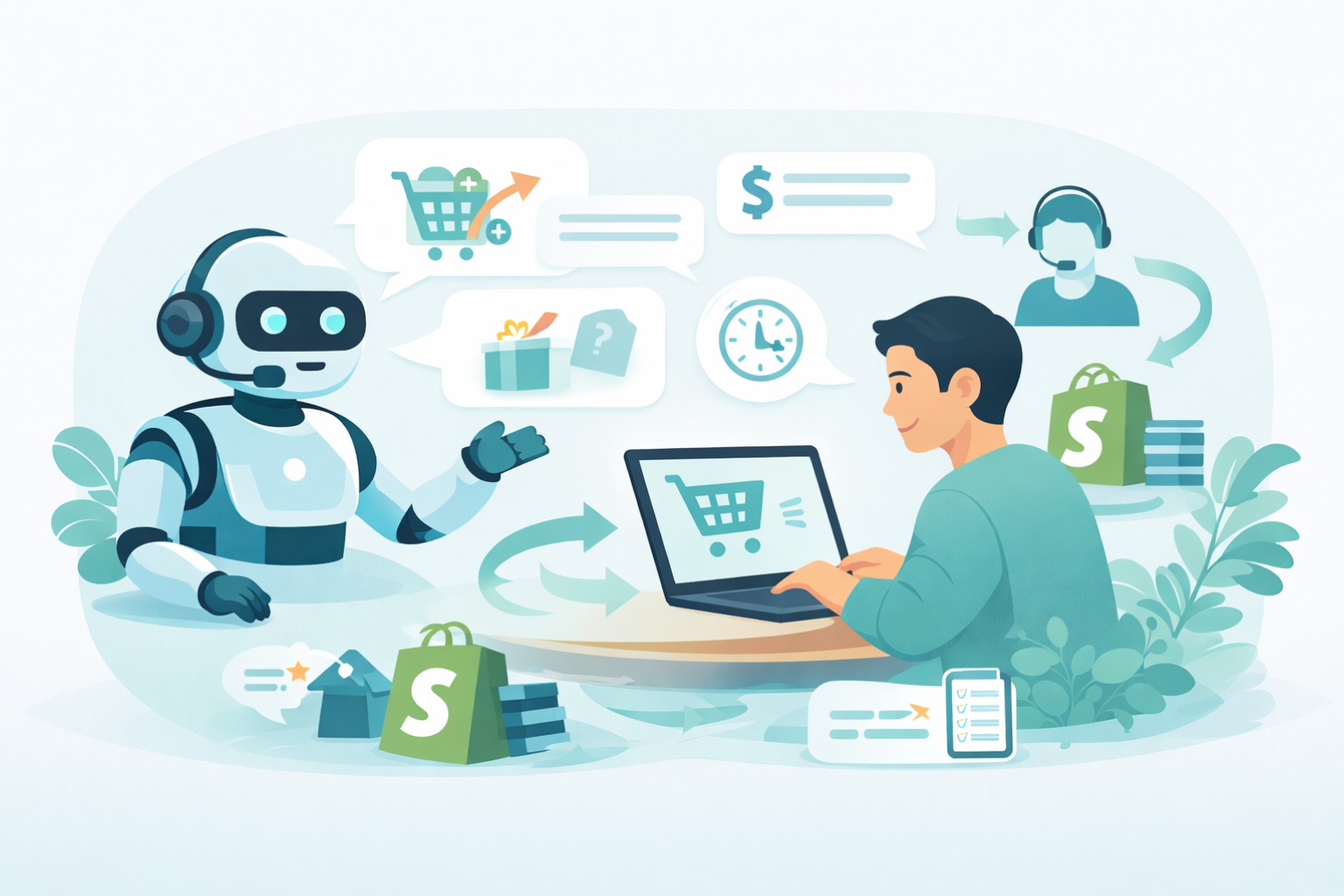
A Shopify AI chatbot can do two jobs at the same time. It can help more visitors turn into buyers, and it can reduce the amount of repetitive work your support team has to handle every day.
That combination matters because most ecommerce stores do not struggle with traffic alone. They struggle with friction. Customers hesitate, get confused, cannot find the right product, cannot find policy information, or leave because they do not get help at the moment they need it. A well built AI chatbot can remove a large part of that friction when it is connected to the right store data and trained on the right content.
A good chatbot improves conversion because it helps shoppers make decisions faster. It reduces support load because it handles the same questions that human agents answer again and again. The value is not in the chat window itself. The value comes from what the assistant can actually do with context, store data, product information, policy content, and customer intent.
Why conversions are lost in the first place
Most online stores lose conversions for ordinary reasons. A customer is interested, but one or two questions remain unanswered. They may want to know whether a product fits their needs, how long delivery takes, whether returns are easy, what size to choose, whether a product works with another item, or whether there is a better option at the same price. If those questions are not answered fast enough, the shopper delays the decision or leaves.
This problem becomes larger in stores with many products. Poor product list usability, weak filters, unclear catalog structure, and missing policy information make it harder for shoppers to move forward. Customers do not only search for products. They also search for answers. If the store does not help them quickly, many of them leave.
An AI chatbot does not solve all of that by itself, but it can remove a large amount of friction if it helps people find products, understand differences, and get policy answers without hunting through menus and pages.
How a Shopify AI chatbot improves conversions
It answers buying questions at the point of decision
The biggest conversion lift often comes from answering the right question at the right moment. A customer browsing a product page does not want a general sales pitch. They want help that is specific to what they are looking at right now.
Is this product right for my use case?
What is the difference between these two options?
Will this arrive before a certain date?
Does this material work for dry skin, small apartments, or beginner users?
What should I buy with this?
This is where a Shopify AI chatbot becomes useful. Instead of making shoppers search through categories and filters alone, the assistant can interpret intent and guide them toward a better decision. That shortens the time between interest and purchase.
It improves product discovery
A search bar only works well when the customer already knows what to type. Many shoppers do not. They think in goals, problems, and preferences. They say things like “I need a gift under $100” or “show me something for sensitive skin” or “I want a sofa for a small room.”
AI shopping assistants are useful here because they can work from conversational intent, product signals, and user behavior rather than exact keyword matches. Better relevance helps customers find suitable products faster, which can improve discovery, basket size, and repeat purchase potential.
This matters directly for conversion. If people can find the right product quickly, fewer sessions end in frustration.
It enables better cross sell and upsell suggestions
A good chatbot can do more than answer questions. It can recommend related products based on what the shopper is considering, what is already in the cart, or what similar customers usually buy.
These recommendations can appear at multiple points in the journey, including product pages, cart flows, and post purchase moments. This can increase average order value as well as conversion. A shopper who receives a useful recommendation is more likely to feel confident that they are buying the right set of items.
It keeps the shopper inside the buying flow
Traditional support often breaks the buying flow. The customer clicks away to read a policy page, opens another product tab, sends an email, or leaves to ask a question later. Every extra step creates risk.
A chatbot can keep the conversation inside the shopping journey by answering policy questions, product questions, and practical questions in the same place. The more help a customer gets without leaving the current flow, the lower the drop off risk.
It can personalize the conversation
Personalization matters because shoppers do not all need the same answer. AI assistants can personalize using browsing behavior, cart contents, past purchases, account status, and other in session signals when available.
That can improve conversions in simple but important ways. The chatbot can recommend the right category faster, narrow down options, adapt to budget or use case, and answer in a way that feels relevant rather than generic.
How a Shopify AI chatbot reduces support load
It handles repetitive questions automatically
A large portion of ecommerce support is repetitive. Customers ask about delivery time, returns, exchange policy, order status, product compatibility, ingredients, materials, stock, discounts, and setup. These questions are necessary, but they do not always require a human.
A chatbot can take on many of these repeated requests, especially when it is connected to a strong knowledge base and store content. That does not mean human support disappears. It means the support team spends less time on repeated basic requests and more time on the cases that actually need judgment.
It gives instant answers around the clock
Customers do not ask questions only during business hours. A chatbot can answer at any time, which matters for international stores, late night browsing, and urgent pre purchase concerns.
For support teams, this reduces backlog pressure. For customers, it reduces waiting. Both effects help the business.
It reduces the volume that reaches agents
The more common questions a chatbot resolves on its own, the fewer tickets and chats need a live person.
This is one of the biggest operational benefits for merchants. Even if the chatbot does not resolve everything, reducing just the first layer of repetitive requests can have a large impact on team workload.
It shortens agent handling time when escalation is needed
A chatbot is not only useful when it fully resolves the issue. It can still save time before a human takes over. For example, it can collect the order number, identify the topic, summarize the issue, and present the relevant context.
That means the support agent does not have to start from zero. Support efficiency improves most when AI reduces the work around the answer, not just the wording of the answer.
Why the same chatbot can help both sales and support
In ecommerce, sales and support often overlap. A shopper who asks about returns before buying is still a sales opportunity. A customer who asks whether two products differ in size, material, or performance is somewhere between product discovery and support.
This is why the most useful Shopify AI chatbots are not built only as FAQ bots. They sit in the space between store assistant, buying guide, and support layer.
That is also why implementation matters so much. A generic chatbot with no product understanding will not create much value. A chatbot connected to the right store content, catalog structure, and support knowledge can improve both outcomes at once.
What makes a Shopify AI chatbot actually effective
Good product data
If the store data is vague, incomplete, or badly structured, the chatbot will struggle. The AI can only recommend and explain products it can understand.
That means product titles, descriptions, attributes, images, use cases, variants, and category structure all matter. Better store data leads to better chatbot answers.
Clear policy content
Many support conversations are driven by uncertainty around returns, shipping, exchanges, warranties, and other store rules. A chatbot performs much better when it has a clear source of truth for policies and FAQs.
If the store content is weak or scattered, the chatbot will either fail to answer or answer with low confidence.
Real context
A chatbot becomes much more useful when it knows what page the user is on, what is in the cart, what the visitor has browsed, and where in the journey the question is being asked.
This context allows the chatbot to answer in a much more practical way. Instead of giving a general reply, it can talk about the exact product in front of the shopper or recommend related items that make sense.
Smart escalation
Not every conversation should stay with AI. The assistant should know when to stop, when to ask for clarification, and when to route the case to a person.
That matters for sensitive workflows such as refunds, unusual order issues, exceptions, or high value customers. The best systems use AI with clear human backup, not AI as a forced replacement for all support.
Where merchants usually go wrong
They install a chatbot without preparing store content
This is probably the most common mistake. Merchants expect the tool to compensate for weak product pages, missing FAQs, unclear policies, and inconsistent catalog structure. It does not work that way.
AI amplifies the quality of the inputs it receives. If the store content is messy, the chatbot will also be messy.
They treat it as only a support tool
If the chatbot is only answering policy questions, it is underused. The bigger upside usually comes from helping visitors choose products, compare options, and move toward purchase.
The strongest return often comes when the chatbot supports both buying and support journeys.
They measure only chat volume
A chatbot should not be judged only by how many messages it sends. Better metrics are conversion rate, assisted revenue, average order value, ticket deflection, first response speed, resolution rate, handoff rate, and customer satisfaction.
They do not review failed conversations
The fastest way to improve a chatbot is to study where it fails. Look at unanswered questions, weak answers, unexpected intent, and cases where people abandon.
Those failures usually reveal gaps in content, structure, or logic.
How to measure whether it is working
If a Shopify AI chatbot is meant to increase conversions and reduce support load, measure both sides.
For conversion, watch:
conversion rate from sessions with chatbot engagement
assisted revenue
add to cart rate after chat
average order value
product page exit rate
checkout start rate
For support, watch:
ticket volume
live chat volume
first response time
agent handling time
percentage of conversations resolved without escalation
percentage of repeated question types
customer satisfaction for AI assisted conversations
The goal is not just more chat activity. The goal is better outcomes.
What a realistic outcome looks like
A realistic goal is not that the chatbot replaces the support team. A better goal is that it handles the first layer of repetitive demand, helps more shoppers find the right product, and gives agents cleaner handoffs when human help is needed.
For some stores, the main gain will be better conversion on high intent traffic. For others, it will be lower support workload after purchase. For larger catalogs, the benefit may come from product finding and recommendation quality. The exact mix depends on the store.
But the overall pattern is clear. AI is most useful when it helps people discover products, get answers faster, and move through the shopping journey with less friction and less manual support effort.
Final thoughts
A Shopify AI chatbot increases conversions when it helps customers make decisions faster and with more confidence. It reduces support load when it answers repetitive questions, provides help at any hour, and sends only the right cases to human agents.
Those two outcomes are connected. Every unanswered question hurts conversion, and every repetitive question drains support capacity.
The stores that get the most value from AI chatbots are usually the ones that do the basics well. They organize product data, write clear policy content, structure their catalog, review chat logs, and use AI as part of the buying experience rather than as a decorative widget.
Better context, better content, and better resolution usually lead to better commercial results.
Frequently asked questions
How can a Shopify AI chatbot increase conversions?
A Shopify AI chatbot can increase conversions by answering buying questions quickly, improving product discovery, suggesting related products, reducing friction during the shopping journey, and helping shoppers feel confident before they purchase.
How does a Shopify AI chatbot reduce support load?
It reduces support load by handling repetitive questions such as shipping, returns, order status, product details, and compatibility questions. It can also collect context before handing a case to a human agent.
Can the same Shopify AI chatbot support sales and customer service?
Yes. A well connected Shopify AI chatbot can help with product recommendations, pre purchase questions, cross sell suggestions, order support, and general store policies in one conversation flow.
What data does a Shopify AI chatbot need to work well?
It works best when it has access to clean product data, pricing, policies, FAQs, cart context, and where appropriate, authenticated customer order information.
Why do some Shopify AI chatbots fail to deliver results?
Most failures come from weak store content, poor product data, missing policy information, limited integrations, and no process for monitoring failures and improving responses over time.
References
Shopify. AI Personal Shopper: How AI Agents Can Help Customers Shop. March 17, 2026.
Shopify. AI in Ecommerce: 7 Ways to Get Started in 2026. Updated March 26, 2026.
Shopify. AI Recommendation Systems: A Complete Guide. April 3, 2026.
Baymard Institute. E Commerce Product Lists and Filtering UX.
Baymard Institute. E Commerce Search Needs to Support Users’ Non Product Search Queries.
Baymard Institute. Product List UX 2025: 8 Common Pitfalls and Best Practices.