How an AI Chatbot Helps Customers with Order Tracking, Returns, and FAQs
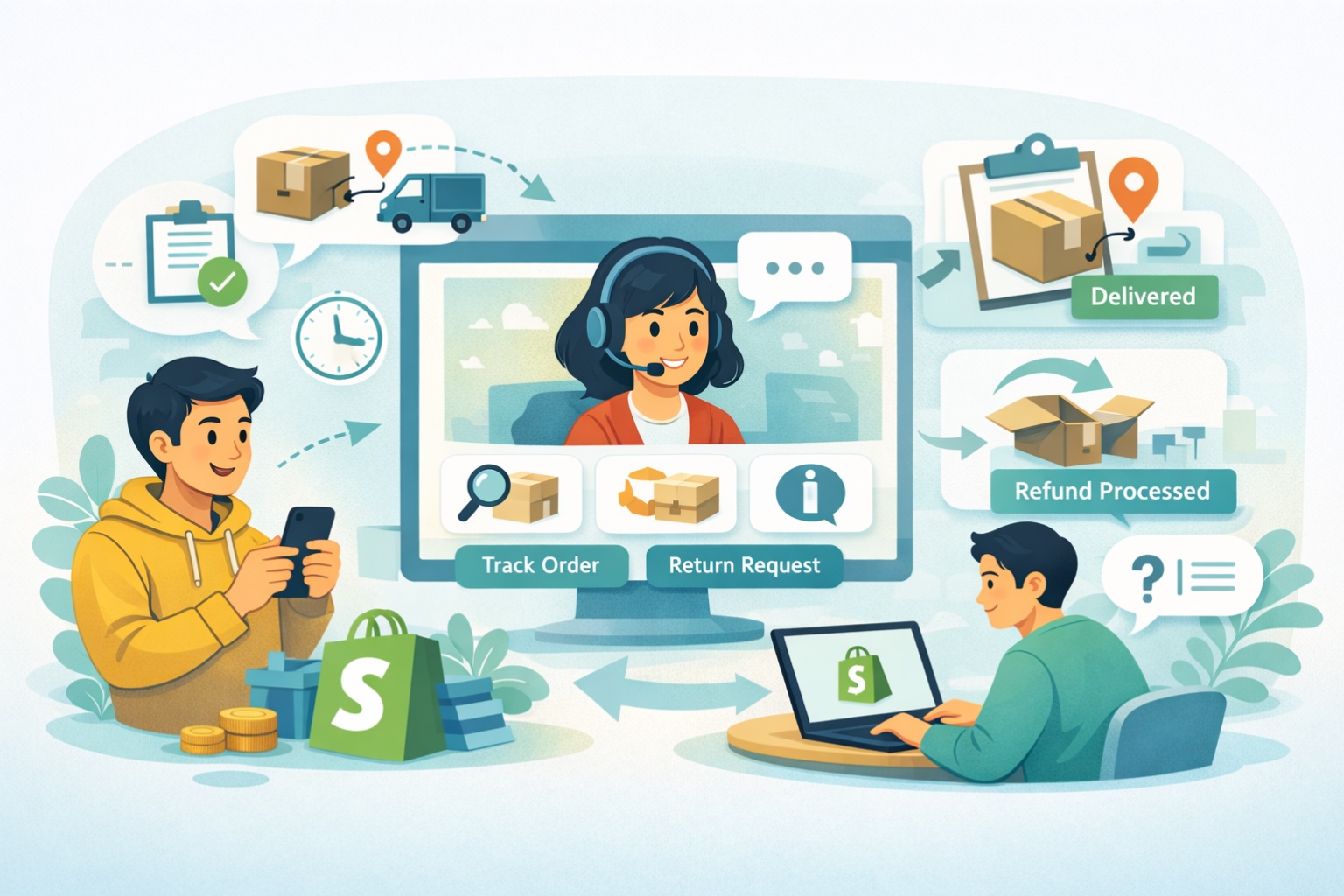
When a customer places an order online, three questions almost always follow: "Where is my order?" "What if I need to return it?" and "How does this even work?" These are not complex questions. But they are constant ones. And the sheer volume of them is what breaks most customer support systems.
Traditional support teams are expensive, limited by working hours, and slow to scale. A customer waiting 24 hours for a reply about a delayed shipment is a customer who might not come back. That is a real business problem, and it is exactly the kind of problem AI chatbots are built to solve.
This article takes a close look at how AI chatbots handle the three most common customer service needs: order tracking, returns and refunds, and FAQs. It examines how the technology works, what results businesses are actually seeing, and what still requires human attention. If you run an ecommerce business, manage a customer service team, or are evaluating AI tools, this guide covers what you need to know.
What Is an AI Chatbot in the Context of Customer Service?
An AI chatbot is a software program that uses natural language processing (NLP) and machine learning to understand what a customer is asking and respond with relevant, accurate information. Unlike older rule-based bots that followed a fixed decision tree, modern AI chatbots can interpret questions phrased in different ways, remember context within a conversation, and connect to backend systems to pull live data.
The distinction matters. A rule-based bot might only recognize "track order" if the customer types exactly that phrase. An AI chatbot can understand "where's my package," "I haven't received my stuff yet," and "my order hasn't arrived and it's been a week" as variations of the same request.
Modern customer service chatbots are typically built on large language models (LLMs) or specialized conversational AI platforms. They are integrated with a company's order management system (OMS), customer relationship management (CRM) software, logistics APIs, and returns portals. That integration is what makes them genuinely useful rather than just conversational.
The Scale of the Problem They Solve
Before getting into the mechanics, it is worth understanding the scale of what AI chatbots are addressing.
According to Salesforce's State of Service report, 83% of customers expect to interact with someone immediately when they contact a company. IBM estimates that businesses spend over $1.3 trillion annually on customer service interactions globally. Zendesk's Customer Experience Trends Report found that 60% of customers say long hold times are the most frustrating part of a service experience.
Order status inquiries alone make up approximately 30% to 40% of all inbound customer service contacts in ecommerce, according to research from Narvar. During peak seasons like the holiday shopping period, that number can go even higher. Hiring seasonal agents to absorb that volume is costly and rarely seamless.
AI chatbots offer a direct response to these numbers. They handle high volumes without wait times, operate continuously, and cost a fraction of what human agents cost per interaction.
How AI Chatbots Handle Order Tracking
Order tracking is the single most requested customer service function in ecommerce. Customers want to know where their package is, when it will arrive, and what happened if there is a delay. They want this information instantly and without friction.
Connecting to Real-Time Logistics Data
A well-built AI chatbot does not guess at order status. It pulls live data from the carrier and the order management system. When a customer asks "Where is my order?", the chatbot:
-
Authenticates the customer using their email address, order number, or account login.
-
Queries the OMS or the carrier API (such as FedEx, UPS, USPS, DHL) in real time.
-
Interprets the current shipment status (in transit, out for delivery, delayed, delivered).
-
Delivers a human-readable response with the latest tracking update.
The whole process takes a few seconds. A human agent doing the same task would need to open the order record, locate the tracking number, visit the carrier website, read the status, and relay it to the customer. The chatbot eliminates every manual step.
Proactive Order Updates
AI chatbots are increasingly being used not just reactively but proactively. Instead of waiting for a customer to ask, the system sends automated messages when a package ships, when it is out for delivery, or when an unexpected delay occurs. These proactive notifications reduce inbound contacts because the customer already has the information they would have asked for.
Research from Convey (now part of Project44) found that 98% of shoppers say shipping impacts their brand loyalty, and 69% are less likely to shop with a retailer again after a poor delivery experience. Proactive updates, delivered through chatbots or SMS, directly address this by keeping customers informed without them needing to chase information down.
Handling Delivery Exceptions
Delivery exceptions (missed deliveries, wrong address flags, customs holds, weather delays) create a spike in customer contacts. AI chatbots are trained to recognize these situations and offer specific next steps. If a package shows a customs hold, the chatbot explains why and tells the customer what action they may need to take. If a delivery was attempted but missed, the chatbot provides instructions for rescheduling.
This is where the conversational capability of AI earns its value. A customer who types "my package says delivered but I didn't get anything" needs more than a status update. They need guidance. A trained AI chatbot recognizes the "marked as delivered but not received" pattern, acknowledges the frustration, initiates a trace request with the carrier, and sets expectations for how long resolution will take, all in a single conversation flow.
How AI Chatbots Manage Returns and Refunds
Returns are the second most common point of customer contact, and they carry more emotional weight than order tracking. A customer who wants to return something may be disappointed, frustrated, or confused about the process. How that interaction is handled directly affects whether they buy again.
Walking Customers Through Return Eligibility
Return policies vary by retailer, product category, purchase date, and condition of the item. Customers rarely read the fine print before buying. When they want to return something, they need someone to tell them whether they can and how.
An AI chatbot checks return eligibility automatically. When a customer says "I want to return my jacket," the chatbot:
-
Identifies the customer and locates the specific order.
-
Checks the purchase date against the return window.
-
Confirms whether the item category is eligible for return.
-
Asks the reason for the return (wrong size, defective, change of mind).
-
Guides the customer through the appropriate return path.
This process replaces what would otherwise be a back-and-forth email exchange or a phone call. It also removes human inconsistency. Every customer gets the same accurate answer based on the same policy.
Generating Return Labels and Initiating Refunds
The most valuable feature here is action, not just information. AI chatbots integrated with returns management platforms like Loop Returns, Returnly, or a custom returns portal can generate prepaid return shipping labels on the spot, send them to the customer's email, and log the return in the system.
For instant refund models (where the refund is issued before the returned item is received), the chatbot can trigger the refund automatically once eligibility is confirmed. This removes an entire layer of human processing from a high-volume workflow.
According to Happy Returns, a UPS company, 96% of customers say they would shop with a retailer again if the return experience was easy. The chatbot is the front door of that experience.
Handling Exchanges
Many customers do not want a refund. They want the right size, the right color, or a different product entirely. AI chatbots can manage exchange flows by checking inventory availability, reserving the replacement item, processing the exchange request, and triggering the return of the original item all in one conversation.
This matters for businesses because exchanges retain revenue. A return converted to an exchange is a retained sale. Chatbots that handle exchanges well are doing more than customer service. They are doing retention.
Escalating Complex Return Cases
Not every return is straightforward. Damaged goods, suspected fraud, missing items, and gifts without receipts require judgment that AI is not always equipped to make independently. Good chatbot design includes clear escalation pathways. If the system detects a situation outside defined parameters, it routes the customer to a human agent with full context already attached to the ticket.
This handoff is critical. A poorly designed chatbot that cannot escalate gracefully creates more frustration than no chatbot at all. The best systems treat escalation as a feature, not a failure.
How AI Chatbots Answer FAQs
FAQ handling is where AI chatbots first proved their value in customer service, and it remains one of their most reliable use cases. Every business has a set of questions they answer thousands of times per week. Shipping times, payment methods, size guides, product compatibility, store hours, subscription cancellation, loyalty points. These questions are predictable. They have correct answers. And they do not require human empathy to resolve.
Building a Knowledge Base the Chatbot Can Use
An AI chatbot answers FAQs by drawing on a structured knowledge base. This can be a manually curated set of question and answer pairs, a help center or documentation library, product catalogs, or a combination of all three. Modern AI chatbots using retrieval-augmented generation (RAG) can search across large knowledge bases and construct accurate answers from multiple sources.
The quality of the chatbot's FAQ responses depends almost entirely on the quality of the knowledge base it references. Businesses that invest in well-structured, regularly updated help content get better chatbot performance. Businesses that feed their chatbot stale or incomplete information get incorrect answers that erode customer trust.
Handling Ambiguous Questions
Customers do not phrase questions the way a company writes its FAQs. "Do you ship to Canada" and "Can I get this delivered internationally" are the same question with different words. AI chatbots trained on real customer conversation data get better at recognizing intent regardless of phrasing.
This is where NLP does its heaviest lifting. The system identifies the semantic intent of a question and matches it to the right content, even when the wording does not match exactly. This is a capability that has improved significantly with large language models, which are trained on vast amounts of conversational text and can generalize across phrasing variations.
Personalized FAQ Responses
Basic chatbots give the same answer to everyone. AI chatbots with access to customer account data can personalize. A customer logged into their account who asks "When does my subscription renew?" gets an answer specific to their account. A customer asking "What are my loyalty points worth?" gets their actual balance, not a generic explanation of the rewards program.
This kind of personalization increases answer relevance and reduces follow-up contacts. The customer gets what they actually needed, not a general policy statement they have to apply to their own situation.
Multilingual FAQ Support
For businesses operating across multiple countries, FAQ handling in a single language is a limitation. AI chatbots with multilingual capability can detect the customer's language and respond accordingly. Google, Amazon, and Meta have published research showing that large language models can operate across dozens of languages with reasonably high accuracy, though performance varies depending on how commonly a language appears in training data.
For ecommerce businesses expanding into non-English markets, a chatbot that answers FAQs in the customer's native language removes a significant barrier to trust and conversion.
The Business Case: What the Numbers Say
The return on investment for AI chatbots in customer service is well documented, though the specific numbers vary depending on implementation quality, industry, and baseline support costs.
Cost Reduction
IBM reports that chatbots can handle up to 80% of routine customer inquiries. Forrester Research found that AI-powered customer service can reduce costs by 30% or more. The cost per interaction for a chatbot ranges from $0.25 to $0.50 on average, compared to $6 to $12 or more for a human-handled phone or chat interaction, according to data from Gartner.
For a business handling 100,000 support contacts per month, even a partial automation rate represents millions of dollars in annual savings.
Resolution Time
Resolution speed is as important as cost. Average handle time for a human agent on a simple order inquiry is between 4 and 8 minutes when accounting for hold time, lookup time, and wrap-up. A chatbot resolves the same inquiry in under 30 seconds in most cases.
Tidio's customer service automation research found that 62% of consumers would prefer interacting with a chatbot rather than waiting for a human agent for simple queries. Speed is a quality of service, not just an efficiency metric.
Customer Satisfaction
The relationship between AI chatbots and customer satisfaction (CSAT) scores is nuanced. Well-implemented chatbots that resolve inquiries accurately improve CSAT. Poorly implemented ones that give wrong answers or fail to escalate damage it.
Drift's Conversational Marketing report found that 55% of businesses using AI chatbots generate more high-quality leads, while Intercom data shows that businesses using their chatbot reduced customer response times by 43% on average. When chatbots work well, customers notice. When they do not, customers remember.
Agent Productivity
AI chatbots do not just replace human work. They improve the quality of human work. By handling tier 1 inquiries automatically, they free human agents to focus on complex, high-value interactions. Agent satisfaction improves when the job is not answering the same basic question 200 times a day.
Zendesk's benchmark data shows that companies using AI assistance see agent productivity improvements of 20% to 35%, depending on the use case and the level of AI integration.
What AI Chatbots Still Cannot Do Well
Honesty about limitations is essential to any serious evaluation of this technology.
Emotionally Charged Situations
A customer who received a damaged wedding gift, a parent whose child's birthday present did not arrive, a person dealing with a billing error on a tight budget. These situations require emotional intelligence that current AI cannot reliably provide. Natural language models can generate empathetic-sounding responses, but customers in distress can often tell the difference.
Best practice is to identify emotional signals in conversation (words like "furious," "devastated," "unacceptable," or extended complaining) and route those conversations to human agents quickly.
Novel or Edge Case Problems
AI chatbots are trained on historical data. They handle what they have seen before. A unique situation that does not match any training pattern or knowledge base entry will produce a poor response. The system either gives a generic answer or gets confused. Good chatbot design anticipates this and includes fallback logic: when confidence is low, escalate.
Complex Policy Judgment
Deciding whether to honor a return outside the window for a high-value customer, approving a refund for a situation that falls in a gray area, handling a dispute that involves both shipping failure and product defect. These are judgment calls that require authority and context that chatbots typically do not have. Human agents with the ability to make exceptions are still necessary for resolution rates to remain high.
Building Genuine Relationships
Customer loyalty is built on trust, consistency, and feeling genuinely valued. A chatbot can be efficient and accurate, but it cannot replicate the experience of speaking to a knowledgeable, caring person. For premium brands where relationship quality is a competitive differentiator, AI should support human agents rather than replace them.
Implementation Considerations for Businesses
If you are evaluating or deploying an AI chatbot for order tracking, returns, and FAQs, here are the key considerations based on current best practices.
Integration Depth Matters More Than Features
A chatbot with deep integration into your OMS, CRM, and returns portal will outperform a feature-rich chatbot with shallow integrations. Real-time data access is what separates a genuinely useful chatbot from one that gives outdated or wrong information. Before selecting a platform, map every system the chatbot needs to connect with and confirm native or API-based integration is available.
Training Data Quality Drives Accuracy
Your chatbot will only be as good as the data you train it on. This includes your product catalog, return policy documents, shipping carrier integrations, historical customer conversation data, and FAQ content. Investing in a clean, well-structured knowledge base before launch will reduce the rate of incorrect responses and improve customer trust.
Design for Escalation
The chatbot's job is not to handle everything. Its job is to handle what it can and hand off what it cannot, seamlessly. Build escalation rules around query type, emotional signals, conversation length, and topic complexity. When the chatbot escalates, the receiving human agent should get the full conversation context, the customer's account details, and a summary of what was attempted. No customer should have to repeat themselves.
When the chatbot escalates, the receiving human agent should get the full conversation context, the customer's account details, and a summary of what was attempted. No customer should have to repeat themselves.
Measure the Right Things
Common metrics for chatbot performance include containment rate (the percentage of conversations fully resolved by the bot without human escalation), first contact resolution rate, average resolution time, and CSAT score post-chatbot interaction. Track these metrics from day one and use them to identify topics where the bot underperforms so you can improve training data and logic.
Compliance and Data Privacy
Customer conversations handled by AI chatbots involve personal data including names, addresses, order details, and sometimes payment information. Any chatbot deployment must comply with applicable data privacy regulations including GDPR in Europe, CCPA in California, and PIPEDA in Canada. Ensure the platform you choose offers data encryption, audit logs, and clear data retention policies.
Industry-Specific Applications
Ecommerce and Retail
This is the largest market for AI customer service chatbots. The volume of order-related inquiries during peak periods like Black Friday, Cyber Monday, and the holiday season creates an almost impossible staffing challenge. AI chatbots absorb the spike without the lead time required to hire and train seasonal agents.
Retailers like H&M, Sephora, and Zara have deployed conversational AI across web and mobile channels, with reported deflection rates (queries resolved without human intervention) ranging from 60% to 80% for transactional inquiries.
Logistics and Delivery Companies
FedEx, UPS, DHL, and regional carriers use AI chatbots on customer portals and via SMS to handle the enormous volume of "where is my package" queries. These chatbots are connected directly to the carrier's internal tracking systems, providing shipment visibility down to the scan level.
Financial Services
Banks and fintech companies use chatbots for transaction inquiries, dispute initiation, and policy FAQs. While order tracking is not directly applicable, the returns equivalent in financial services (dispute resolution and refund processing) follows very similar workflow logic.
Healthcare and Telehealth
Patient-facing chatbots handle appointment scheduling, billing questions, insurance FAQ inquiries, and prescription refill status. The "returns" equivalent here is appointment cancellation and rescheduling, which follows the same eligibility-check-and-action pattern as ecommerce returns.
The Role of Generative AI in Next-Generation Customer Service Chatbots
The current generation of AI chatbots is moving beyond scripted responses and retrieval-based answers. Generative AI, powered by large language models like those underlying Claude, GPT-4, and Gemini, enables chatbots to construct original, contextually appropriate responses rather than selecting from a fixed set of answers.
This has practical implications for FAQ handling in particular. Rather than matching a customer's question to a pre-written answer, a generative AI chatbot can synthesize information from multiple sources and write a response tailored to the specific question. This handles the long tail of unusual or highly specific questions that would have stumped a retrieval-based system.
For returns, generative AI enables more natural conversations around edge cases, with the system reasoning through eligibility based on policy documents rather than relying on hardcoded rules. This is still an emerging capability and requires careful testing to ensure accuracy, but the direction is clear: chatbots are becoming more capable of handling nuanced situations over time.
Agentic AI, where the system can take independent actions (like initiating a return, booking a delivery resubmission, or crediting a loyalty account) without human approval for low-risk actions, is also entering commercial deployment. Companies like Klarna have reported that their AI assistant handled the equivalent of the work of 700 full-time agents within its first month of deployment, resolving two-thirds of customer service chats without human escalation.
Common Mistakes Businesses Make with Customer Service Chatbots
Understanding where implementations go wrong helps avoid the same errors.
Understanding where implementations go wrong helps avoid the same errors.
-
Deploying before the knowledge base is ready. A chatbot launched with incomplete or inaccurate content will give wrong answers and damage customer trust faster than having no chatbot at all.
-
Not designing for mobile. More than 70% of ecommerce traffic comes from mobile devices according to Statista. A chatbot that works well on desktop but poorly on mobile misses most of its potential audience.
-
Setting unrealistic automation targets. Expecting a chatbot to resolve 95% of contacts without human support leads to forcing the bot into situations it cannot handle well. A realistic containment rate for most deployments is 50% to 75% for the first year, improving with training data over time.
-
Ignoring post-conversation feedback. Customer satisfaction ratings and post-chat surveys on chatbot interactions are goldmines of improvement data. Businesses that do not collect and act on this feedback leave performance improvement on the table.
-
Making escalation too hard. Some businesses try to maximize containment by making it difficult to reach a human agent. Customers recognize this and it creates significant frustration. Easy escalation actually improves overall satisfaction with the chatbot experience because customers feel they have a safety net.
Conclusion
An AI chatbot is not a shortcut or a cost-cutting trick. When built and deployed properly, it is a genuinely better way to handle the most common, most predictable, and most time-sensitive needs of customers: knowing where their order is, returning something that did not work out, and getting a quick answer to a specific question.
The evidence from deployments across industries is consistent. Businesses that invest in good integrations, quality knowledge bases, and thoughtful escalation design see real reductions in support costs, real improvements in resolution speed, and real gains in customer satisfaction. The businesses that deploy chatbots as an afterthought see the opposite.
For customers, the bar is simple: answer my question accurately and quickly, and do not make me repeat myself. For businesses, the path to meeting that bar runs directly through the AI chatbot. Not because it is new technology, but because it is now mature enough to deliver on the promise consistently, at scale, around the clock.
That is not a small thing. In customer service, speed and accuracy build trust. And trust, more than any single interaction, is what keeps customers coming back.
Frequently Asked Questions
Can an AI chatbot handle order tracking without a human agent?
Yes, if it is connected to the order management system and carrier APIs. It can authenticate the customer, pull live shipment data, interpret the status, and present the latest update in plain language.
How does an AI chatbot help with returns and refunds?
It can check return eligibility, identify the order, ask the reason for return, guide the customer through the right workflow, and in some setups generate return labels or trigger refunds automatically.
What kinds of FAQs are best handled by an AI chatbot?
Shipping questions, payment methods, return policies, size guides, product compatibility, store hours, subscription questions, and loyalty program questions are all strong FAQ use cases because they are repetitive and usually have clear answers.
When should a chatbot escalate a conversation to a human?
It should escalate when the issue is emotionally charged, falls outside normal policy rules, looks like fraud or damage, or when the chatbot has low confidence in the answer.
Can AI chatbots reduce customer service costs?
Yes. They can lower costs by handling high volumes of routine inquiries, reducing average resolution time, and freeing human agents to focus on complex or high value cases.
What integrations matter most for a customer service chatbot?
The most important integrations are the order management system, CRM, logistics or carrier APIs, returns platform, and the business knowledge base. Without these connections, the chatbot cannot give reliable real time answers.
Do AI chatbots replace customer support teams completely?
No. They work best as a first layer for routine questions and fast actions. Human agents are still needed for exceptions, judgment calls, and emotionally sensitive situations.
References
-
1. Salesforce. (2022). State of Service Report, 5th Edition. Salesforce Research.
-
2. IBM. (2023). The Value of Training AI: How IBM Watson Assistant Reduces Customer Service Costs. IBM Institute for Business Value.
-
3. Zendesk. (2023). Customer Experience Trends Report. Zendesk Inc.
-
4. Narvar. (2022). The State of Returns: What Today's Shoppers Demand. Narvar Inc.
-
5. Convey / Project44. (2021). The State of eCommerce Delivery: Consumer Research Report. Project44.
-
6. Happy Returns. (2022). 2022 Consumer Returns Research Report. Happy Returns, a UPS Company.
-
7. Forrester Research. (2022). The Total Economic Impact of AI-Powered Customer Service. Forrester Consulting.
-
8. Gartner. (2022). Gartner Predicts Conversational AI Will Reduce Contact Centre Agent Labour Costs by $80 Billion in 2026. Gartner Inc.
-
9. Tidio. (2023). Customer Service Chatbot Statistics and Trends. Tidio Ltd.
-
10. Drift. (2022). The State of Conversational Marketing. Drift.com Inc.
-
11. Intercom. (2023). The Intercom Customer Support Trends Report. Intercom Inc.
-
12. Google Research. (2023). Massively Multilingual Speech: 1000+ Languages, 1 Model. Google AI Blog.
-
13. Statista. (2023). Share of Mobile Commerce in Total Ecommerce Transactions Worldwide. Statista Digital Market Outlook.
-
14. Klarna. (2024). Klarna AI Assistant Handles Two-Thirds of Customer Service Chats in Its First Month. Klarna Press Release.
-
15. Loop Returns. (2022). The True Cost of Returns: Benchmarks for Ecommerce Businesses. Loop Returns Inc.
-
16. Zendesk. (2022). Benchmark Report: How AI Improves Agent Productivity. Zendesk Inc.
-
17. H&M Group. (2022). Annual Report and Sustainability Report. H&M Group.
-
18. Sephora. (2021). Sephora Virtual Artist and Chatbot: Customer Experience Innovation. LVMH Innovation Awards Report.
-
19. Forrester Research. (2023). AI and Automation in Customer Service: A Framework for Investment Decisions. Forrester Consulting.
-
20. Gartner. (2023). Magic Quadrant for Enterprise Conversational AI Platforms. Gartner Inc.